Victorian Early / Crinoline · 1840s · American
Production
handmade
Material
cotton
Culture
American
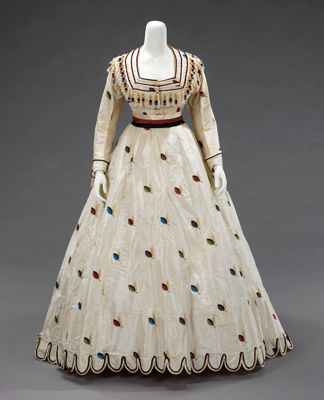
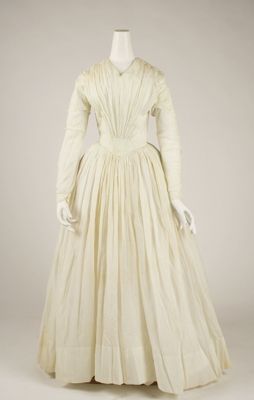
This 1840s cotton day dress exemplifies early Victorian silhouette with its characteristic fitted bodice and voluminous bell-shaped skirt. The cream-colored cotton fabric appears to be a fine weave, possibly muslin or lawn. The bodice features a high neckline with what appears to be a small collar, long fitted sleeves that taper to the wrist, and a natural waistline emphasized by the contrast between the snug upper body and expansive lower portion. The skirt extends in graceful folds to floor length, requiring substantial yardage to achieve this dramatic circumference. Vertical pintucks or pleating detail the bodice front, creating subtle textural interest while maintaining the period's preference for modest coverage and structured fit.
Follow this garment wherever the graph leads
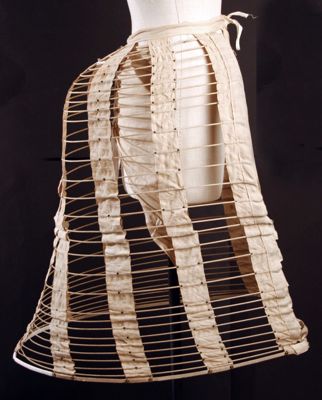
The cream cotton dress's knife-sharp pleats radiating from that impossibly tiny waist tell the story of what's hidden underneath—first the bell-shaped crinoline cage of the 1850s, then thirty years later, the rear-focused bustle frame with its architectural grid of steel hoops.
Match Breakdown
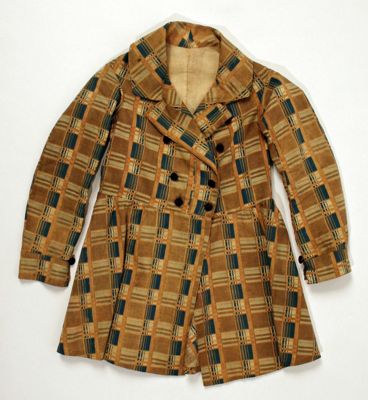
The plaid coat's sharp tailoring and that confident double-breasted stance speaks the same Victorian language as the cream dress's pristine pleating and fitted bodice, but they're having entirely different conversations about femininity. Where the earlier dress whispers propriety through its demure gathering and bell-shaped silhouette, the later coat practically shouts sophistication with its bold geometric pattern and military-inspired structure.
Match Breakdown
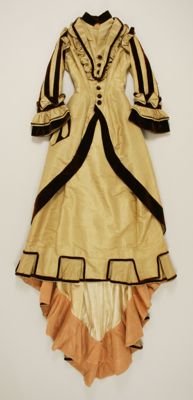
These two dresses trace the Victorian silhouette's dramatic transformation from the 1850s bell-shaped crinoline to the 1880s bustle's architectural rear projection.
Match Breakdown
These two cream dresses reveal how the same impulse toward decorative restraint played out across vastly different silhouettes and social contexts. The earlier Empire gown uses tiny scattered motifs—those jewel-toned teardrops dotting the skirt like confetti—to animate an otherwise severe neoclassical line, while the later Victorian dress achieves similar visual interest through the geometric precision of its pintucked bodice and the scalloped trim marching along the hem.
Match Breakdown