V&A
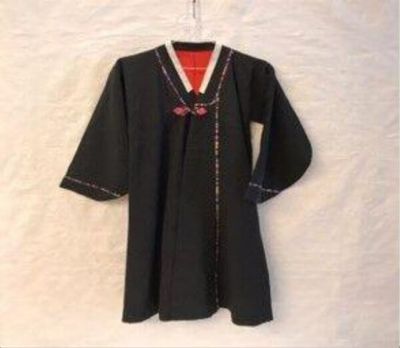
Black Silk Hanbok Jeogori with Red Lining
Korean Traditional · 1980s · Korean
Production
handmade
Material
silk
Culture
Korean
Influences
traditional Korean hanbok construction · Joseon Dynasty court dress
A traditional Korean hanbok jeogori jacket in black silk with contrasting red lining visible at the neckline. The garment features the characteristic short, cropped silhouette of a jeogori with wide three-quarter sleeves that taper at the wrists. White collar bands frame the neckline, and decorative pink and white ribbon ties (otgoreum) hang from the front closure. Red and white geometric embroidered trim adorns the sleeve edges and front opening. The jacket displays traditional Korean construction with its wrap-front design that ties at the side rather than using buttons or other Western closures. The silk appears to have a subtle texture, and the overall proportions follow classical hanbok geometry with the short jacket length designed to be worn over a full-length chima skirt.
Pull the Thread→
Follow this garment wherever the graph leads
dressa-lineknee length
Connected To
V&ARoaring Twenties / Art Deco · 1920s
V&AKorean Traditional · 1980s
Influences·traditional Korean hanbok construction
SHARED60 years · cross-category