Roaring Twenties / Art Deco · 1920s · Japanese
Production
handmade
Material
cotton
Culture
Japanese
Movement
Art Deco
Influences
Art Deco geometric patterns · traditional kuruma wheel motif
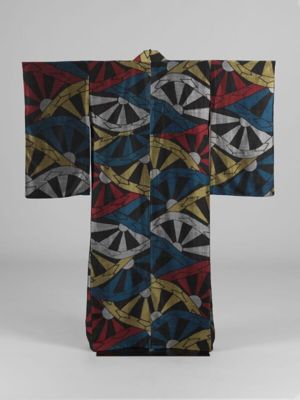
This summer kimono displays a bold geometric pattern of overlapping carriage wheels (kuruma) rendered in a dynamic resist-dyed technique. The wheels appear in alternating colors of deep navy blue, burgundy red, and golden yellow against contrasting backgrounds, creating an energetic all-over design. The cotton fabric shows the characteristic flat weave suitable for warm weather wear. The kimono follows traditional T-shaped construction with wide sleeves and straight body panels. The resist-dyeing technique creates crisp, clean edges between color blocks, reflecting the period's embrace of modern graphic design sensibilities while maintaining traditional Japanese garment structure and cultural motifs.
Follow this garment wherever the graph leads
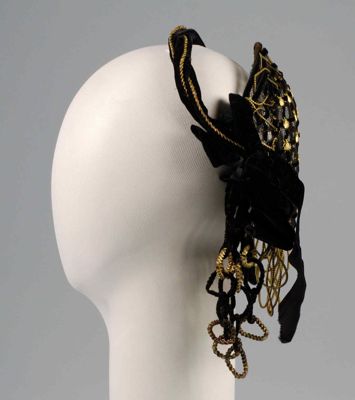
These pieces capture the fascinating cross-pollination of the 1920s, when Art Deco's geometric fever infected everything from Manhattan penthouses to Tokyo textile mills. The American headdress translates the movement's angular obsessions into sculptural black silk and gold beadwork that could have crowned a Ziegfeld girl, while the Japanese kimono takes those same sharp-edged sensibilities and renders them in bold carriage wheel motifs that slice across the cotton in jewel-toned triangles.
Match Breakdown
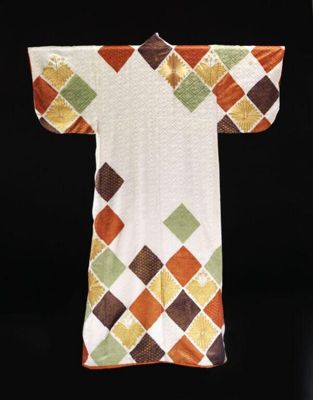
The first kimono's scattered diamond patches in autumn tones feel almost quilt-like against the cream silk, while the second's bold carriage wheels tumble across dark cotton in a dizzying Art Deco rhythm. Both use geometric repetition to animate their surfaces, but where the earlier piece whispers with its delicate patchwork placement, the 1920s version shouts with mechanical modernity — those interlocking wheels could be spinning off a factory floor.
Match Breakdown
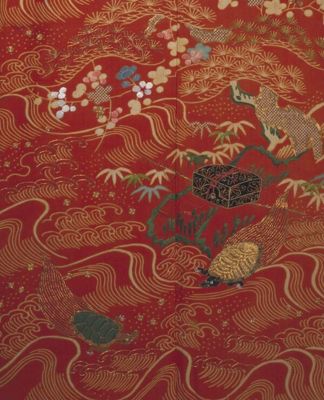
These two kimono capture Japan's textile traditions navigating wildly different moments of cultural exchange with the West. The earlier red silk crêpe flows with classical motifs—those sinuous gold streams and scattered blossoms speak the refined language of Meiji-era luxury, when Japan was carefully packaging its aesthetic for Victorian appetites.
Match Breakdown
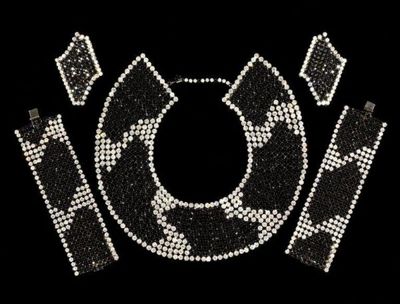
The rhinestone collar's angular geometry and the kimono's stylized carriage wheels both pulse with Art Deco's machine-age rhythms, though they're separated by six decades and an ocean. Where the kimono translates traditional Japanese motifs through the lens of 1920s modernism—those wheels becoming bold, intersecting circles in jewel tones—the 1980s necklace strips the same geometric language down to pure crystal mathematics.
Match Breakdown